

Practical Work in AI, WS26

Hands-on with Deepfake Generators:
Face Swap and Voice Cloning

Week №03
Oleksandr Shytyk | K12429859
Supervisor: Shah Nawaz
Institute of Computational Perception

JKU Johannes Kepler University Linz
Institute of Computational Perception

1. Task and Selected Generators

Task from the last meeting

  • Pick 2–3 generators from SpoofCeleb or ILLUSION.
  • Understand how their pipelines work.
  • Include face manipulation: audio and visual.
  • Measure the quality of the generated content.

Setup constraints

  • Apple M5, 16 GB, no CUDA GPU.
  • One isolated conda environment per generator.
  • Pinned versions; no releases from the last two weeks.

Selected generators

Face swap + voice clone reproduce ILLUSION's four classes: RA-RV, RA-FV, FA-RV, FA-FV

GeneratorModalitySource paperWhy this one
Roop (inswapper_128) via FaceFusionFace swap, videoILLUSION, Set AOne-shot, no training, runs without CUDA
XTTS-v2Voice-cloning TTSILLUSION, Set A; MLAADUsed in two of the three papers; EN and DE
Chatterbox V3 (TTS + VC)TTS and voice conversionBilingual SpoofCeleb; MLAADYour TTS system; one codebase covers TTS and VC

Sources: ILLUSION, App. B.1; Bilingual SpoofCeleb, §3; MLAAD v11, Table IV.

2. How the Generators Work

Face swapILLUSION · Set A

  • ArcFace turns one source photo into a 512-number identity vector.
  • Each target frame: face detected, aligned, cropped to 128×128.
  • The generator redraws the crop with the source identity.
  • Pasted back with a soft mask, frame by frame.

XTTS-v2ILLUSION · MLAAD

  • A short reference recording becomes speaker latents.
  • A GPT-2-style decoder predicts audio tokens one by one.
  • HiFi-GAN turns the tokens into a 24 kHz waveform.
  • Sampling is random; the model decides when to stop.

Chatterbox V3SpoofCeleb · MLAAD

  • T3 language model: text → speech tokens (content, prosody).
  • S3Gen flow matching renders them in the reference timbre.
  • A vocoder makes the waveform; a Perth watermark is added.
  • VC skips T3 and re-voices real source speech.
Takeaway:Each artifact follows from the pipeline: 128 px crop → blur and seams; no temporal model → overly stable identity; autoregressive decoding → missing stop token.

Sources: ILLUSION, App. B.1; XTTS (arXiv 2406.04904); Chatterbox repository and model card.

3. Face Manipulation

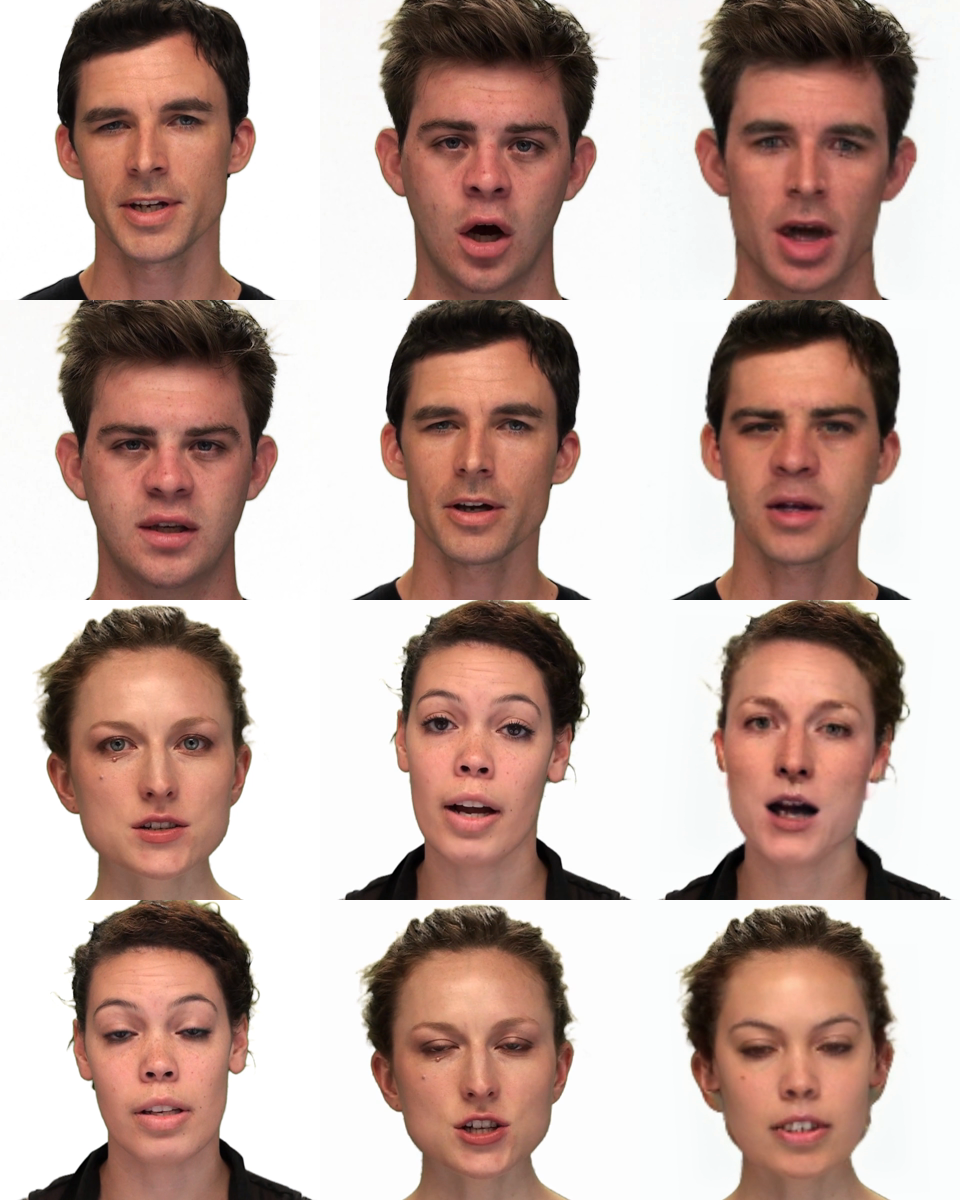
Four pairs: source, target and swap
Rows: 4 pairs · columns: source | target | swap
Real Actor 04, original
Fake Actor 02 → actor 04

Observed artifacts

  • Pose, expression and hair come from the target.
  • Face is soft: drawn at 128×128, then upscaled.
  • Pair 02→04: dark mouth, seam at the cheek.
Takeaway:Identity transfers (ArcFace 0.90 vs 0.92 for real); texture does not (face BRISQUE 33.8 → 43.7).

Data: RAVDESS actors 01–04 (CC BY-NC-SA); same-sex pairs, one source frame per pair (ILLUSION protocol).

4. Voice Cloning

Same sentence, same speaker: actor 01

EN: “Kids are talking by the door.” · DE: “Die Kinder unterhalten sich an der Tür.”

SampleConditionLengthListen
Real recordingHeld-out take of actor 01, never used as a reference1.6 s
XTTS-v2Cloned from ~15 s of actor 01's other recordings2.0 s
Chatterbox TTSCloned from the same reference1.7 s
Chatterbox VCActor 03's real speech re-voiced as actor 011.8 s
Chatterbox TTS, DECross-lingual: actor 01 never spoke German2.8 s
XTTS-v2, DEFailure: keeps talking after the sentence (actor 03)9.5 s
Note:Volume normalised for this call; raw XTTS output is 10–20× louder than the real recordings.

Data: RAVDESS, Thorsten-Voice (CC0). Reference: six S2 clips per speaker; S1 held out as ground truth.

5. Audio-Visual Composition

ILLUSION Set A protocol for one target: actor 03

32 clips in total: RA-RV 4 · RA-FV 4 · FA-RV 12 · FA-FV 12

RA RV
Original
RA FV
Actor 01's face
FA RV
Actor 01's cloned voice
FA FV
Actor 01's face and voice

Controls

  • Identical encoding: H.264 CRF 23, AAC 48 kHz.
  • Fake audio loudness-matched and onset-aligned.

Limitation

  • No lip-sync, as in ILLUSION.
  • In FA-* clips, mouth and audio do not match.

Chatterbox TTS shown as the fake audio; XTTS and Chatterbox VC versions exist for every target.

6. Quality Metrics

Audio: mean per file, real second take as baseline

GeneratorWER ↓Speaker sim. ↑MCD, dB ↓Sec / charFAD ↓ (real-vs-real)
Real (2nd take)0.0090.9681.910.058–
XTTS-v20.0190.9243.290.1012.33 (0.26)
Chatterbox TTS0.0100.9412.780.0581.59 (0.40)
Chatterbox VC0.0000.9172.870.053Sample too small

Face swap: 137 face crops per side

ClipsBRISQUE face ↓ID sim. to sourceID stability over timeFID face ↓ (real-vs-real)
Real (RA-RV)33.80.922 (same person)0.977–
Swap (RA-FV)43.70.9000.98736.0 (5.3)
Takeaway:Chatterbox is more realistic than XTTS, and no fake matches a second real recording.

From the papers: BRISQUE, FAD (ILLUSION); Whisper WER (Bilingual SpoofCeleb). Added: speaker similarity, MCD, sec/char, FID.

7. Lessons for Detection

What the metrics show

  • Whisper misses XTTS overruns (WER = 0).
  • ArcFace is fooled; texture metrics are not.
  • German clones lose 0.09–0.12 similarity.

Shortcuts a detector could learn

  • Loudness: XTTS is 10–20× louder.
  • Watermark: every Chatterbox file carries Perth.
  • Codec: differs unless re-encoded.
  • Lip-sync: audio does not match the mouth.

Link to the three unseen conditions

ConditionObservation
Unseen languageCross-lingual fakes keep quality but lose speaker similarity
Unseen generatorEach generator fails differently: XTTS overruns, Chatterbox is unusually clean
Unseen identityNot covered yet: only five speakers
Takeaway:The detection signal sits in texture and spectral detail, not in content or identity.

Shortcuts were controlled in this set by identical encoding and loudness matching.

← → navigate · F fullscreen